Sheep Dog Comes Home
and stops shredding the couch

For someone whose tax classification is writer, it’s been far too long since I’ve sent out a newsletter. I’ve been busy. Too many updates. Let’s play the I-could-tell-you-about game.
I could tell you about the conversations I’ve been having with grief facilitators in Europe, and the semester abroad I almost took in Denmark, and the trip to the Tamera ecovillage in Portugal that I booked and then canceled. And the study abroad I am planning for this spring.
I could tell you about the 70-person men’s grief ritual I attended in September, and the beauty I saw there.
I could tell you about the restorative justice process I helped facilitate at a song festival last summer. And the strange dissonance of visiting Stafford Creek prison just two days afterwards.
I could tell you about a painful rupture I experienced with a community member, and the beauty that unfolded as I sought support. And the lessons learned, oh, the lessons learned.
I could tell you about the thousand-person ritual event my friends produced at St. Marks Cathedral in Seattle, in which a woman indigenous to this continent stood up and sang a haunting song under a 50-foot wide sculpture of earth. And how her voice reverberated mightily in that cathedral, and how she invited us to sing along. And when she finished, she told us: That was a victory song. I sang it because this building used to be unsafe to my people. And now I am here singing with you.
And I could tell you how I wept tears of thanksgiving in that cathedral, just a week prior to that federal holiday, that ‘day of erasure’ as indigenous activist Alyx Somas puts it, Thanksgiving.

I could tell you about the ancestor ritual Alyx Somas hosted on Thanksgiving weekend. And how a person whose ancestors fought in the German army during World War II, and a person whose ancestors were European Jews shared stories together, sang, cried, and reached out to one another. And as their hands clasped, a faerie glow seemed to emanate, and I had the distinct sense of healing going forward and backward in time. And there too, what could I do, but cry in the presence of beauty.
And I could tell you about my first grief ritual as lead facilitator, which I hosted earlier this month in Olympia. How I played the piano for the participants as they lay about the room exhausted by a good grieving (and I will tell you more, read on…)
I could tell you about my pursuit of funding for practices of resiliency and belonging. How, like a hound on a scent, I am ever closer to that first, critical Yes.
I could tell you about how State Representative April Berg invited me to join a stakeholder advisory group for the formation of a Washington State commission on boys and men (if so formed, the commission would be the only one in the country). And how in the draft bill, under the state seal, the following words I never thought I would hear from government:
“(1) The Washington state boys and men commission shall have the following duties:
(f) Advocate for policies that increase the sense of belonging and decreases isolation and loneliness in boys and men.”
Witness me, shedding tears of gladness, in the glow of my laptop, on a December night.
Confessions of a full-time student
During the heady days of the pandemic and the squirrel project, supporters were sending me about $1,000 a month in support. With all the change in the world, with the loss of my TikTok audience, that support has gradually decreased to about $375.
The Patreon money has been critical to my ability to be a full-time student. At Evergreen I am a unicorn, a 90s throwback—the full-time student. Most of my classmates have multiple jobs and other commitments.
The benefit of being a full-time student—I’ve been able to throw myself into the research and study around community resiliency. I’ve gone much farther than my classmates, to extracurricular trainings, to the halls of government, to Zooms in exotic foreign locales.
The downside is that I am taking on debt and burning through savings. My time as a full-time student is over. In the new year I will be finding a part-time job, possibly through Evergreen. I still plan to complete my studies in June.
I am so grateful for your support over the years. And I could use some help. Probably the single most helpful thing you could do is share this work to people who might be interested. You can also support me on Patreon, and I’m also activating the option of supporting me through this newsletter, though access to these essays will remain free.
Speaking of Patreon—access to my Patreon is also free. I post more frequent updates on Patreon to keep my supporters in the loop. I encourage you to follow me on Patreon and on this newsletter.
###
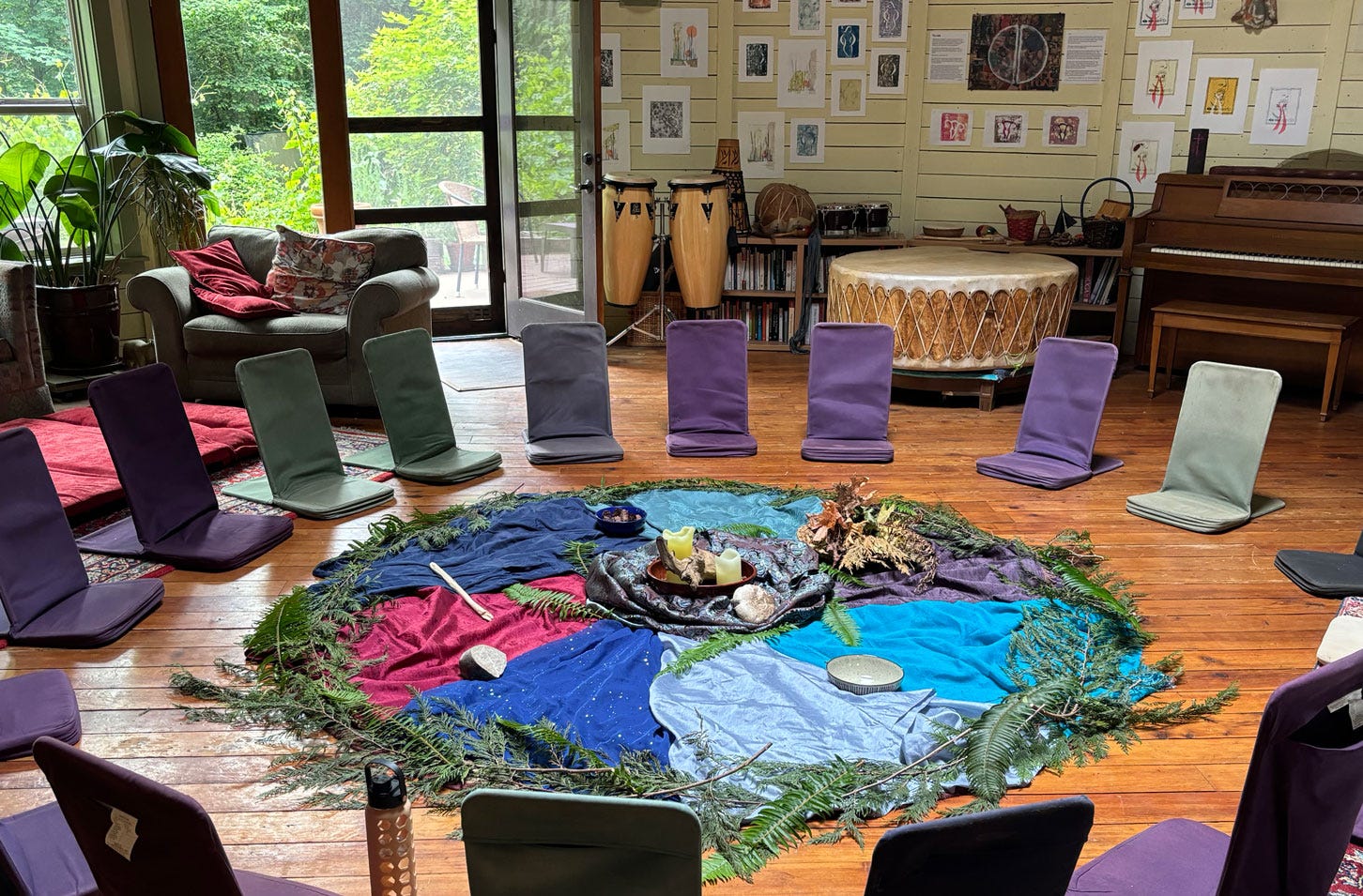
We have forgotten how to grieve. And in forgetting how to grieve, we have forgotten how to live. — excerpt, Olympia Community Grief Ritual description
Sheep Dog Comes Home
1. Working
While you are at the altar I am checking the levels checking the time noticing the lighting shutting off lights tracking the person on the couch have they been attended to tracking the participant with the lost expression walking toward them sensing sensing how are you really where are you do you need help. I am tracking that my assistant is now with the person on the couch, holding them gently, and I am thinking good they are taken care of. I’m noticing the woman in the side room and I am moving toward her judging her expressions her body language: Sad but grounded. Checking in: Are you getting what you need? Yes she says and I believe her. Checking the time checking the energy in the room we are in the downslope we are wailing less and lying quietly at the altar and cuddled up at the couch and some of us are dancing and I go to the piano and I shut off the music and in the silence I spider my hands across the keys not playing yet listening listening to what precisely is the sound that is needed now and then I play that sound. And I hear and feel us sigh.
2. Stepping Forward
When I moved to Olympia I complained that there were no community song circles. Someone should start a song circle, I would say. I told my professor in the social entrepreneurship program and he growled in his Afrikaans brogue, Evan, you will start the song circle. And when I begged off he persisted. Start one this week, he said.
And two months later, I did, when I founded the Evergreen Community Song Circle.
When I moved to Olympia I also complained that there were no community grief rituals. Someone should host a grief ritual, I would say. And I looked around me and saw all my friends in the throes of grief. The friend who lost their relationship, the friend who can’t find community, the friend who is losing their dream of family, the friend who lost their son. And me, the person slowly dying without the support of village.
It’s a strange feeling to look around and realize you’re the one who needs to step up. No one is coming to save us.
Strange too, the power of speaking vision. I saw a vision of a community grief ritual for Olympia. Everyone I talked to said yes. My friends signed up. A dear buddy and talented facilitator agreed to be my co-pilot. A co-housing community opened their doors to me.
It’s strange when things go well. When things fall into place with a satisfying click.
Stranger yet to sit in circle and realize everyone who is there came because I called.
Strangest of all to open my mouth to speak, to say why we’re here, and to know that, today, I’m the one who does it. I take the lead. I hold the talking stick. I will guide us.
My biggest surprise? Those chattering hens in my psyche that tell me I’m not good enough, I’m not doing it right, I’m full of shit--strangely quiet. I was expecting anxiety, perfectionism, imposter syndrome. None of that.
Instead I am suffused by a calm rightness toward the moment, to my role, to the ritual we are about to hold.
I realize that this new feeling is at play, this thing called trust. That I am beginning to trust myself, trust my friends, trust grief, trust ritual. To trust forces much greater than mine.
It is my voice that thanks and greets our ancestors and asks for their help. My voice that speaks to the power and beauty of grieving together. It is my body, my being that telegraphs to the group: We got this.
3. The Malinois
Lately the archetype of the sheep dog has been coming up.
I used to think of myself as neurotic and anxious and too much: Too sensitive, too feeling, too tender, too empathic. But I hold myself differently now. I am inspired by the indigenous idea of original medicine. That there are no mistakes in nature, and humans are no exception. That we all have a unique gift that is essential to the greater unfolding.
So the tender, autistic, queer, highly sensitive little child that I was, the child who felt so small, the child who was told by family, by peers, and by society that they were too much and not enough. I now realize that child carried great gifts.
One of my favorite dog breeds is the Belgian Malinois. They are famously, or infamously, among the most intelligent dogs, tasked with the most difficult jobs. They are rescue dogs, sheep dogs, and military dogs. They can climb fences, open doors, and drive you crazy. They are notorious as pets: Hyperactive, requiring constant activity and exercise, destructive, neurotic. I desperately want one but am wise enough to know I can never have one.
Why am I, the novice dog person, so taken by the most intelligent and neurotic of breeds, an expert-level dog that almost no one is qualified to steward?
There is the old trope that dog owners seek a dog that mirrors their own personality.
So am I a neurotic dog? Or, like the Malinois, am I in the wrong context? The Malinois was never meant to live in an apartment or patrol a backyard. The Malinois was meant to corral great flocks of sheep, to scare off wolves, to be the colleague and friend of a human shepherd.
That was the sense I had, at my first grief ritual. All of my faculties, often my greatest tormenters, found their calling. My overactive empathy allowed me to sense into the interior lives of 16 participants, to read micro expressions in a split second, to judge the overall feeling tone of the collective. My hypersensitivity allowed me to track subtle adjustments in the lighting, the music, the timbre of voices. The communicator in me, the speechifier, found their platform, in teaching about grief, in framing the gathering, in landing us with a poem.
I found myself leaning on all my faculties. I was stretched but not overwhelmed. Instead of my usual thrum of anxiety I felt that new sense of rightness.
A friend and participant later told me, It was so nice to see you in your element.
I continue to marvel at how not nervous I felt before and during the event. I suspect my anxiety was too busy working to raise the alarm.
It helped, too, that I was not alone. There were many sheep dogs present. My three co-facilitators. The participants. Ritual weaved us into something much bigger than our isolated little selves. We are so much wiser as a people. And we can hold so much more.
The Malinois in me, that difficult dog, forever shredding the couch in my apartment, was finally set free. Unleashed, cut loose, with a flock to herd, a ritual to hold. Their little nose quivering, smelling burnt sage and grief, their eyes sharp, missing nothing, their ears flicking to and fro, tracking tones beyond human hearing.
There was never anything wrong with the dog. Always something wrong with the context.
Leading sixteen of us into the valley of grief, I was not afraid.
In the valley of grief, I was right where I belonged.
In the valley of grief, I came home.
Nonrequired Reading and Viewing
Strongly recommend the documentary The Last Ecstatic Days
And Aaron Johnson’s new short documentary, Dark and Tender: The Big Island
Currently reading and loving In the Absence of the Ordinary by Francis Weller
A recent conversation on grief and soul work with Francis Weller and Anderson Cooper. Someday we’ll lure Anderson to a grief ritual.
###
Evan, the power of your writing. Wow. Tears reading this, my heart moved by the ways in which you are following your calling. In your element. I celebrate that, and the gift of your sensitivity, creativity, passion, and devotion to community practices that weave us together in circles of belonging.